
The childhood dream has come true. Now what?
Yes, I redesigned my website again. With a custom-designed visual identity by a professional, an interface designed by a UX designer with years of experience. With my article writer persona relegated to the sidelines and my new career in the spotlight.
The last time this happened, 3 years ago, I decided to write about what was going on in my head. I don't know what I wanted at the time, if I expected someone to read why I was creating a new blog? But looking back today and reading what I wrote makes it all worthwhile, because I really didn't know what was to come in the following months.
How proud I was to say at the time that I would use this space to write creative texts, about the things I liked, to connect people! The truth is, I made a couple of them and then discovered I could use my blog to get game keys for reviews. Even though it was my own space, it became "a mechanical and soulless job," exactly as I had written months before. Not that I was lying in the reviews, or that I wasn't actually praising the games I liked, but the time I spent playing things I thought were terrible just to fulfill a commitment for a job that didn't even exist was kind of ridiculous.
Even funnier is realizing how "creating board games" was almost a footnote, just another thing I tried and didn't work out. Little did I know that, months later, I would sign my first game with a publisher and the career I had genuinely dreamed of since childhood would become a reality.
So, in this new phase, I decided to write again about why this whole change happened. Not because I think anyone will genuinely read this text, but maybe I need to remember what was on my mind in a few years. But if you do read it, I hope it helps you in some way.
The little kid who liked little games
While probably more normal kids dreamed of being astronauts or members of a fantastical royal family, little Gabriel always loved his little games. Digital, board, card games, it didn't matter, if it was a game, I was there. Not that I think that justifies the bullying I suffered at school, but, in retrospect, it was funny to think that even the music I listened to had some connection to a game I liked, for example. I didn't get cars, dolls, or other toys: every birthday I got clothes, food, and board games, the latter being the only thing I asked for.
I still remember the first time I played River Raid on an Atari 2600 emulator on the computer. I remember exploring CD-ROMs of educational games and others with a bunch of nonsensical demos. I remember learning how to download the SWF files of the Flash games I played so I wouldn't need an internet connection back when dial-up was more expensive. I remember when the world of emulators opened up to me and I became obsessed with learning the history of video games that I never had the chance to experience. I remember getting my copy of Risk when I was 6 years old and spending years trying to play it properly. I remember spending afternoons with my cousins playing cards, or whatever else was nearby at the time.
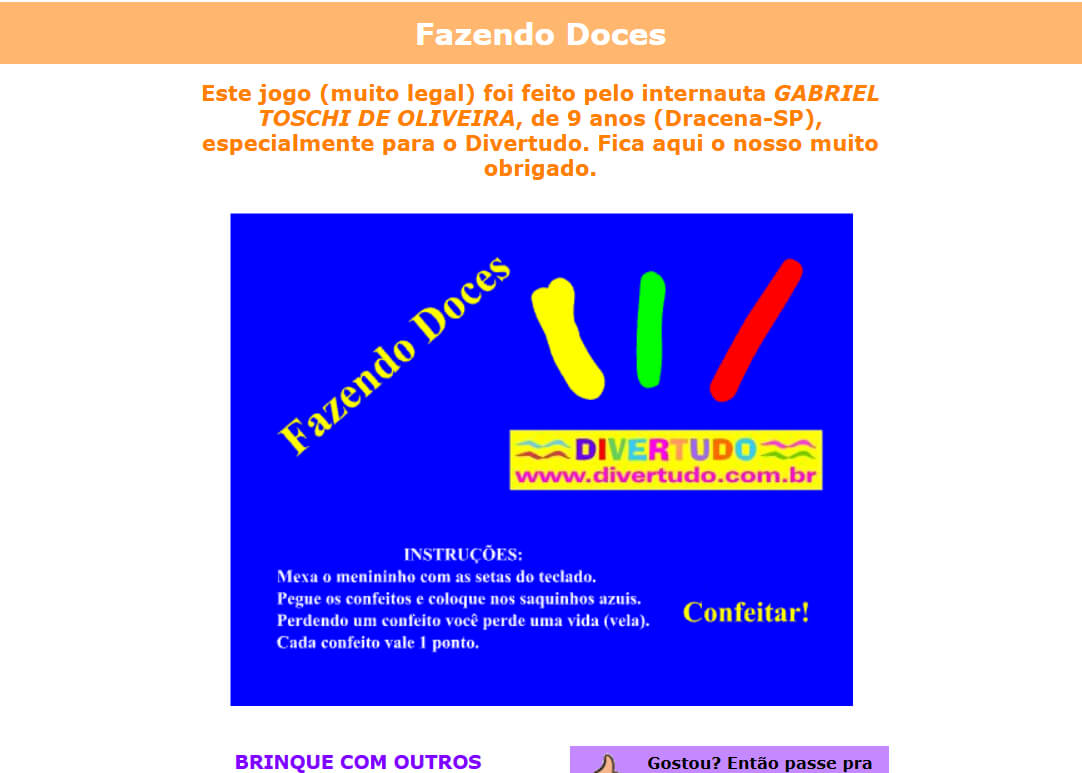
This was my first attempt at "making" a digital game, back in 2007. "Making" because, in reality, I downloaded an SWF game I liked, managed to transform it back into a Flash project, and only changed the visual part. I wouldn't really learn programming for years later, and even today I don't know ActionScript. If you want to look, the Wayback Machine managed to preserve it. The text on the page translates to: "This (very cool) game was made by internet user GABRIEL TOSCHI DE OLIVEIRA, 9 years old (Dracena-SP), especially for Divertudo. Our sincerest thanks to him."
A few years ago, I found an essay I had written when I was 10 years old in one of my dad's files. The topic was "what do you want to be when you grow up?" and the title of my essay made the answer quite clear: "I want to be a game designer". At the time, I honestly didn't know what that really meant, but a good part of the decisions I've made in my life since then have been in pursuit of that dream. I started writing online because I wanted to talk more about games than just being a consumer; I studied Computer Science because, in my words at the time, "whoever creates the game is the one who codes it, right?" (no, they're not)
Today, recently diagnosed with ADHD and well aware of my hyper-fixation, it's easier to understand why games are much more than a hobby or a career. But until recently, it was just something I really liked, that nobody ever gave me much space to talk about, and that I ended up "hiding" from many areas of my life. Even after years of therapy, my relationship with game design only recently became a topic of discussion, when I became convinced that these games I've always enjoyed might have a significant impact on my life.
I remember what state my mind was in when I wrote that text three years ago. During the pandemic, I finally got involved with the Brazilian game design community and tried to make my first prototypes, but none of them were well-received by publishers. Rejecting my game at the time meant rejecting myself as a creative person — and overcoming that anxiety was one of the main mental challenges I've faced in recent years. It's no wonder I thought I could never be a part of that world. Until I could.
Where do I begin?
The article I referred to at the beginning of this was written in December 2023. If my memory serves me right, it would be the following month, at the very beginning of 2024, that Yuri Morroni would call me to prototype a 40-card game for a publisher he had contact with. Snowy Peaks wouldn't be accepted by the publisher, but it would be submitted to the Cardboard Edison Award at the last minute (by a Gabriel who really didn't believe it would get anywhere) and would win 2nd place in the competition, two weeks before the start of that year's Diversão Offline, the biggest board game fair in Brazil. In mid-2024, we would sign our first licensing agreement, which would later result in the release of Snow Climbing by Grok Games.
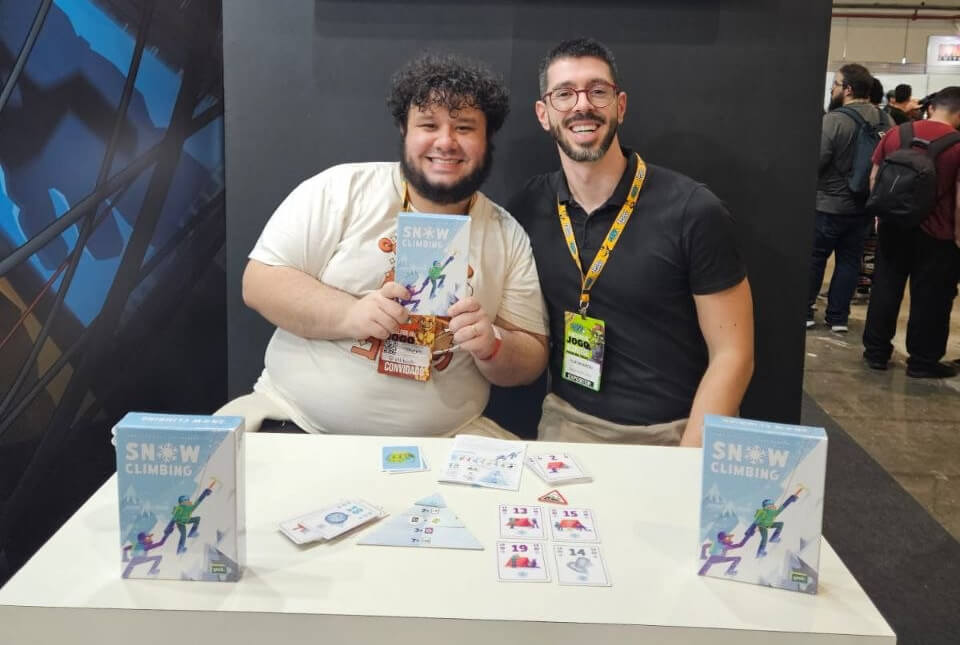
Me and my dearest friend Yuri Morroni, designers of Snow Climbing, during the game's launch at Diversão Offline 2026. I told him that day, and I'll say it again: if it weren't for him, I wouldn't be a game designer today.
Obviously, this gave me an incredible boost and a hope I'd never had before. The second half of 2024 marked the beginning of my search for opportunities, calling contacts, looking for publishers, learning how to pitch, and everything else possible. It was in one of these pitches that I got the chance to create a game from scratch for a Warner Bros. IP, and The Jetsons: O Jogo de Tabuleiro became my second signed game.
Note that up until then I said signed, not released: none of my games had actually reached anyone's hands. So, when Pedro "Cabelinho" came to talk to me at the end of 2024 about the lack of interest from Brazilian publishers in microgames (added to several "No's" I had received recently), I dove headfirst (and without any preparation) into the idea of setting up an independent studio. It was in this madness that Piquinim was born, and a year and a half of work launching microgames about Brazilian culture — from my head came Cobogó, Brigadeiro and Rodízio. In July 2025, Cobogó was finally my first game to reach the public.
I still want to tell the story of each game (and the context surrounding them) in specific design diaries, but I just wanted to prove the point of how bizarrely wrong the Gabriel of 2023 was. In fact, the years that followed were responsible for me being able to say today that I am a professional game designer, just like the 10-year-old me wanted to be. It wasn't (and still isn't) an easy journey — it genuinely came with burnouts, anxiety attacks, and imposter syndrome at its peak — but it's really cool to think that I... did it!? I really did it!
I think I only truly realized this this year, during Diversão Offline. In 2023, I went to the event for the first time, after years of wanting to visit São Paulo for this kind of fair. In 2024, as I said, the focus was on signing Snow Climbing, and we succeeded. In 2025, Piquinim had its own booth in Indie Alley, and I, at the peak of burnout, was just trying to be the "businessman" I never really was, selling my ideas to gamers and publishers who would listen.
But in 2026, I was "just" a game designer. 7 published games (3 of them released during the event), spread across 4 different publishers, of varying sizes and audiences. People playing things I made, laughing and having fun. Influencers coming to talk to me without knowing me because they knew I had made something they liked. Autograph sessions with people I had no idea existed but who were excited to say they were interested in my work.
But amidst all of that, I still remember the scene that truly made me accept what I achieved: a child with their father approached me at the fair because they wanted me to autograph their Jetsons manual. The boy, completely awkward and shy, still managed to tell me that he had really enjoyed it and had fun with his friends. I held back tears (something I'm not able to do now as I write), but it was me there. The child who played and dreamed that he could do that too. Only this time I was on the other side as well.
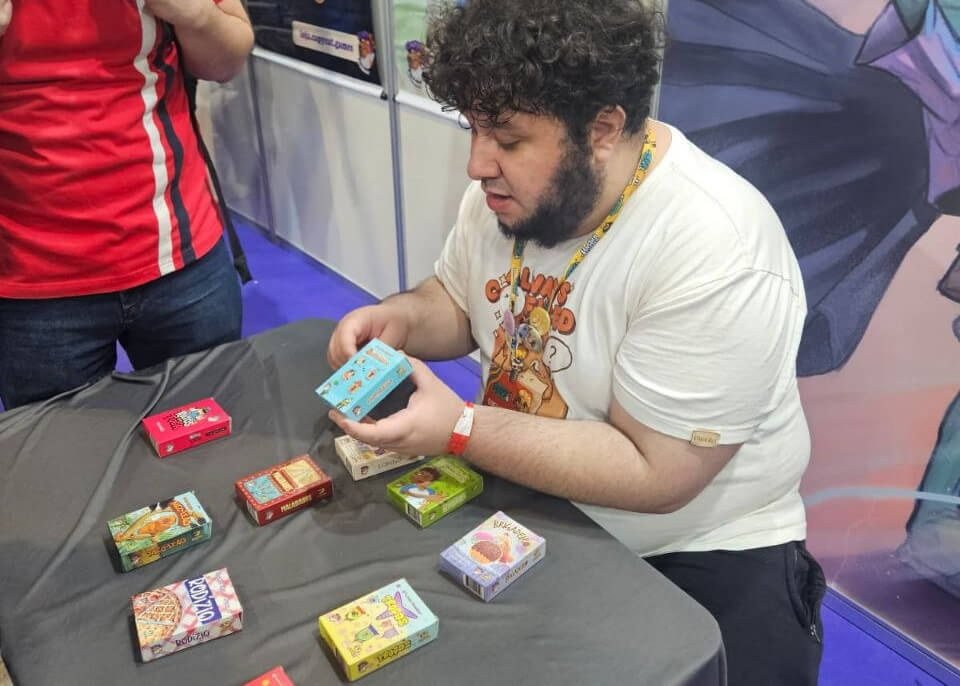
Me during my mornings at the Diversão Offline 2026 at the CapyCat Games' booth, showing, explaining, and playing the 9 (NINE, yes!) games from the Piquinim Collection. I think it was a few minutes after this photo that the child came to talk to me.
I came from a humble family, with a lot of love and little money. "Realizing a dream" wasn't something I could do every week. I think, in reality, I only dreamed about it so much because it seemed so distant, bordering on impossible. In the dream, everything was incredible and wonderful. In reality, it's much more painful and difficult than it seemed. But when that boy came to talk to me, it was truly incredible and wonderful. It's as if the 10-year-old Gabriel was proudly by my side, and all the bad parts of the process had disappeared.
As the days passed after returning home, while I felt very fulfilled, I also began to feel a certain... emptiness? I still don't earn enough money to live off making games, while all the effort to put a title on the market was as laborious as coding by 40 hours a week. The fire of the childhood dream had already faded and was no longer fuel for such a tiring double shift. I achieved what I wanted, and now what?
Do Adults Dream of Electric Games?
It's funny to think that if I had finished the blog a month ago, the ending of this article would be very different. Talk to me a few weeks ago and I would have told you I had a clear plan. "I'm working to make a living making board games," I would have said, adding, "that's why I'm going for every opportunity I can and I'm going to do my best to make most of them work out."
It's no coincidence that, after this year's Diversão Offline event, I think I spent about 5 weeks working on urgent projects for publishers and contacts I made, sending pitches, scheduling meetings. I looked like a well-dressed businessman, just without the suit, the splendor, and the money in the bank. For me, the event had been a success: there were 4 potential contracts to be signed, in addition to other very cool opportunities that would appear in the following months from important conversations that took place there.
Three months later and... almost nothing. Only one contract was signed and several are still pending. Apparently, my time wasn't as valuable as that of several publishers, because the rush they felt while the ball was in my court disappeared as soon as I showed them the prototypes they requested, created in record time. I heard "we're analyzing" or "we still need to see" more times than I expected. Furthermore, even projects that were almost ready to launch started to fall apart. Being a game designer means dealing with frustration all the time, and I hadn't realized the problem of making my income dependent on it. If I already felt bad with it as a "semi-hobby", I don't know what I would do if it were the only way to pay the bills.
I even joked with friends in recent days with a phrase that inspired me to write: "the childhood dream came true and the adult dream ended." Obviously, I was being much more dramatic than I should have been, but seeing so much effort result in so little outcome genuinely made me rethink what I want for the future. I still want to make games professionally, but maybe I need to do a little more on my own terms.
I speak from a privileged position, I know, but I already have a job with a high level of commitment and the salary pays my bills. It's true that "generating value for stakeholders" has never been anyone's dream, and I think making games is genuinely more fun, but... I don't need to make the games successful at any cost, and for some reason that's what I was trying to make happen.
I also think it's important to admit my mea culpa here. Very few people truly make a living as game designers, and usually they've been in the market for decades, with some major successes under their belt. I think it was the desperation of the crazy generative AI bubble growing and dominating the market, along with a certain illusion that it would be "now or never," that motivated me to think this way. It would never work to do in 2 years what many take 20 to achieve, but I needed almost 2 years to understand that.
My idea with this new personal brand, a new website, and a new social media presence has always been to project a more professional image to publishers and companies that don't know me, especially outside of Brazil. It's already difficult to gain a foothold in the international market being Latino, imagine if I seem like just an amateur kid. And at the end of the day, that's what I want to be, a professional game designer, working with companies that will also act professionally, without accepting abusive pitches or poorly thought-out proposals.
Maybe this will close doors for me because some companies only want to take advantage of designers who are pursuing their dreams and hobbies? Maybe. But if I'm going to stress myself out, I'll stress myself out at the job that pays my bills, not at one of the few things that are part of my identity. Now, where will I get to thinking like this? How will I do it? Honestly, I don't think I know yet.
What I'm much more certain of today is understanding why making games is so important to me. Beyond the hyper-fixation and interest in the art itself, why on earth do I enjoy doing this so much?
At the end of the day, I think I enjoy it because I know the power that games have had in my life. The friends I've made, the things I've learned, the stories I've encountered, the worlds I've explored, the puzzles I've solved. Playing and having fun are part of who we are as humans, and if I can create pathways for other people to also have more enjoyable lives, I think the process becomes worthwhile, however difficult it may be.
Of course, I want to one day be able to dedicate myself to this full-time, and all the contracts, money, and professionalism are probably what will allow that to happen. But if I achieve all that and don't feel that my creations are connecting people, the fire will go out. If my games don't have a happy child, a group of friends having fun, a family interacting without a screen... I don't think all this effort will be worth it, because, honestly, it's much more frustrating, painful, and difficult than it seems.
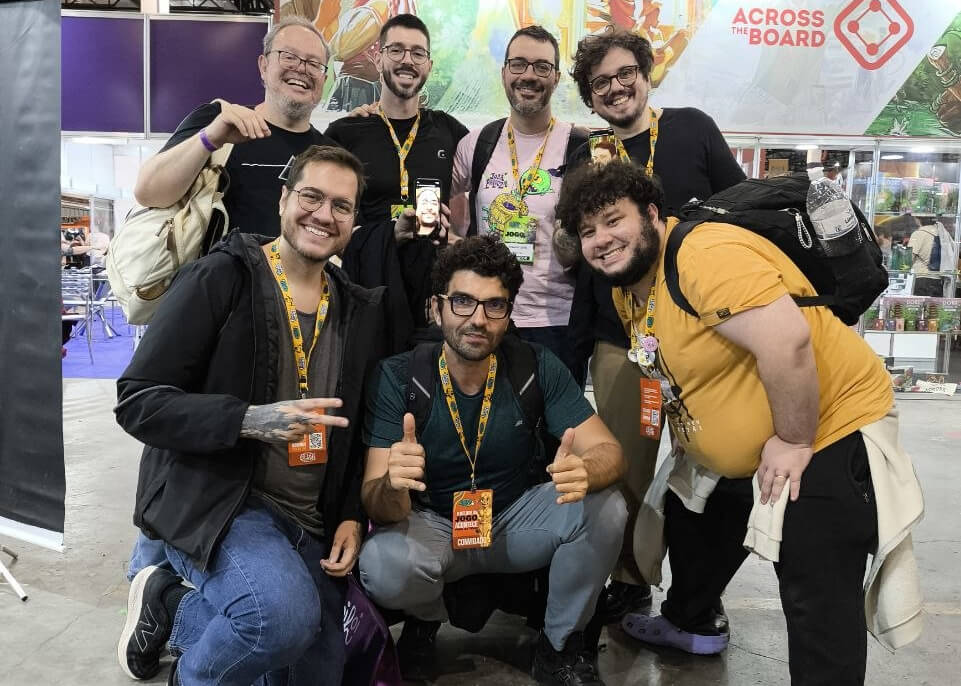
Some of the friends that game design has given me over the last few years, and without their support (and that of many others), I wouldn't be here either. From left to right, top to bottom: Maurício Nóbrega (Guerrinha de Mamona), Yuri Morroni (Snow Climbing, Rolimã), Thiago Leite (Quest Inc, Me Enganei), Lucas Fratini (Fantasmagória, Cafezinho), Arthur Lacerda (Pipoca, ONDA), Bruno Liguori Sia (Rewild: South America) and myself.
Perhaps I'll end this text the way I ended the other one, three years ago: with a much more optimistic dream than I should. Whether that's how adults should dream, I don't know, but I want to believe that I need something more important to achieve than just "being able to pay the bills."
Just as games changed my life, I believe they can change at least a little bit of everyone's life, in some way. Even if it's just one round at a time.